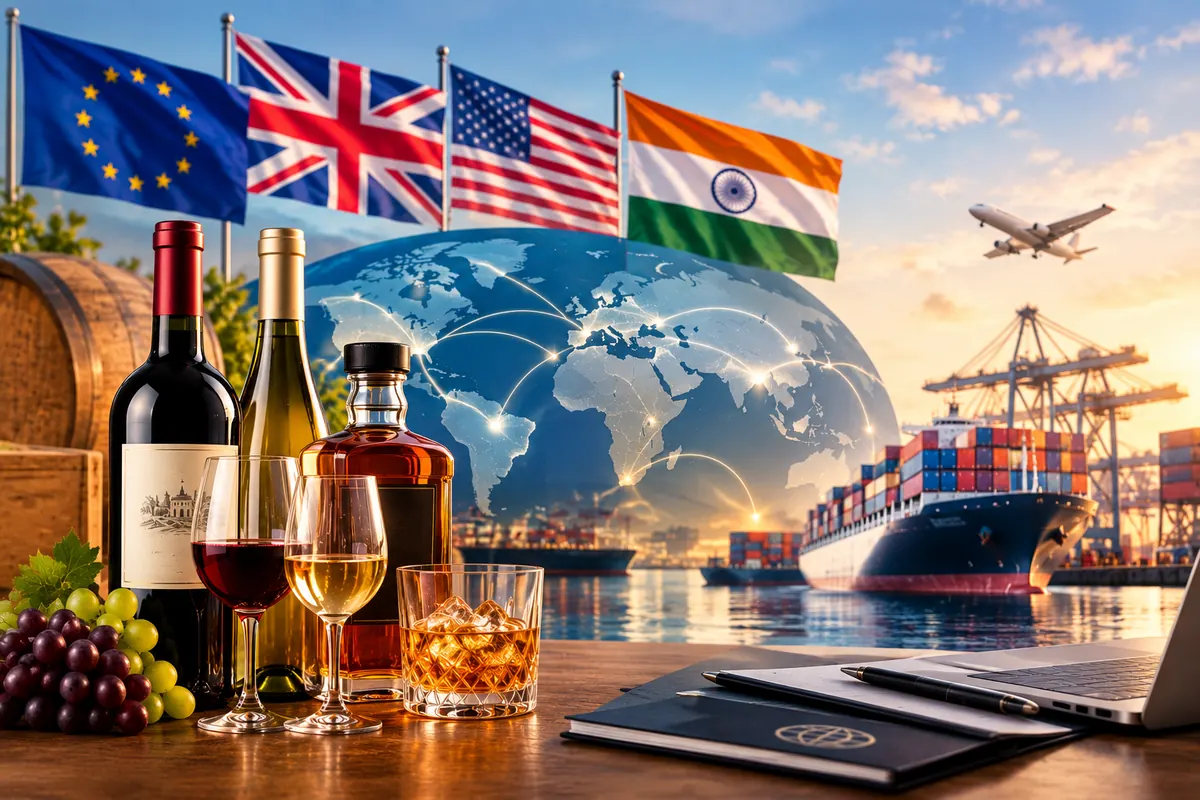
India’s alcoholic beverage market is entering a new phase. Recent trade agreements and tariff reforms have generated significant interest among global wine and spirits producers looking at India as a long-term growth market. While headlines often focus on reduced import duties, the real commercial impact is far more nuanced.
For importers, distributors, investors and brand owners, the important question is not simply whether tariffs have been reduced, but whether India has become a commercially viable market for their products.
The answer depends on much more than customs duty.
Why Trade Agreements Matter
For many years, India maintained some of the world’s highest import duties on alcoholic beverages. Combined with state excise duties, registration fees, distribution margins and logistics costs, imported wines and spirits often reached consumers at prices several times higher than their international retail value.
As India negotiates bilateral and multilateral trade agreements with key trading partners, customs duties on selected alcoholic beverages are beginning to change. These developments have the potential to reshape import strategies, pricing models and market entry decisions over the coming decade.
However, every agreement has its own scope, implementation timeline and product coverage.
Not all beverages benefit equally.
Not Every Category Receives the Same Benefit
One of the biggest misconceptions is that a trade agreement automatically reduces duties across all alcoholic beverages.
In reality, each agreement defines:
- Eligible countries
- Covered product categories
- Phased tariff reductions
- Rules of origin
- Implementation timelines
- Product-specific conditions
For example, one agreement may provide concessions for selected categories of spirits while excluding wine, whereas another may include broader reductions across wines, spirits and beer.
Understanding these distinctions is essential before making sourcing or investment decisions.
Lower Import Duty Doesn't Always Mean Lower Retail Prices
A reduction in customs duty is only one component of the total landed cost.
Once products enter India, they continue to incur costs such as:
- State excise duties
- Label registration fees
- Brand registration charges
- Warehousing and logistics
- Distribution margins
- Retail margins
- State-specific pricing regulations
Because alcohol is regulated independently by each state, the final retail price of the same imported product can vary significantly across India.
In some markets, lower customs duties may improve pricing competitiveness. In others, the benefit may be partially or fully absorbed by downstream costs.
For importers, evaluating the complete landed-to-shelf cost structure is far more important than focusing solely on customs duty.
What This Means for Brand Owners

Trade agreements are encouraging many international producers to reassess their India strategy.
Key questions now include:
- Should products be imported directly or manufactured under licence?
- Which states offer the strongest commercial opportunity?
- Which product categories benefit most from current tariff structures?
- Is premium positioning still the best route, or does a broader consumer segment become viable?
- How should pricing be adjusted without compromising brand value?
The answers vary by category, origin country and target market.
Opportunities for Indian Importers and Distributors
For Indian importers, changing trade policies may create opportunities to diversify portfolios, strengthen premium offerings and introduce brands that were previously considered commercially unviable.
Distributors also need to reassess:
- Portfolio strategy
- Pricing architecture
- Inventory planning
- Supplier negotiations
- State-wise launch priorities
A tariff reduction alone does not guarantee success, but it can significantly improve commercial feasibility when combined with the right distribution strategy.
Creating a memorable brand is crucial in a competitive market. Develop an eye-catching label that reflects your winery’s personality and values. Establish an online presence through a professional website and leverage social media to connect with potential customers. Craft a compelling brand story that resonates with consumers and sets your winery apart from the rest.
Strategic Planning Is More Important Than Ever
As trade agreements continue to evolve, businesses should avoid making decisions based solely on headline announcements.
Successful market entry requires evaluating:
- Applicable customs duties
- Product classification
- State excise regulations
- Registration requirements
- Distribution economics
- Supply chain costs
- Consumer price positioning
Every imported label should be assessed through a comprehensive commercial feasibility model rather than relying on national tariff changes alone.
The wine industry is heavily regulated, and compliance with local, state, and federal regulations is non-negotiable. Familiarize yourself with licensing requirements, labeling regulations, and health and safety standards. Seeking legal counsel can help you navigate the complex regulatory landscape and ensure your winery operates within the bounds of the law.
The Takeaway
India’s evolving trade agreements are opening new opportunities for the wine and spirits industry, but they are not a one-size-fits-all solution.
The commercial success of an imported brand depends on understanding the complete regulatory and financial landscape—from customs duties and excise compliance to state-specific pricing and route-to-market strategy.
At Abhay kewadkar & Associates, we help Exporters, importers, distributors, hospitality businesses and international beverage companies evaluate market entry strategies, regulatory requirements, commercial feasibility and long-term growth opportunities in India’s rapidly evolving alcobev sector.
The businesses that succeed will not simply be those paying lower duties—they will be those making better-informed market decisions.